
One common way that essays go wrong is in failing to properly answer the question. This page will show you how to avoid that pitfall by breaking down the question in order to identify exactly what is being asked of you, allowing you to proceed with the research and writing stages safe in the knowledge that you’re on the right track.
The topic is the general area that the question relates to, and may well correspond to specific lecture or tutorial topics. Many people make the mistake of identifying the question topic and then writing everything they know about it. Instead, you should see the topic more as a general orienting device, allowing you to identify the broad area of interest before focusing down on the actual question being asked.
Identifying the aspect is crucial as it allows you to focus on exactly what is required of you, helping you to avoid including irrelevant material and instead concentrate on the relevant material. For example, in the question ‘Discuss the positive and negative aspects of the internet as a research tool’, you are not being asked to give lots of pros and cons of the internet in general (the topic); rather, you are being asked to focus your answer on the advantages and disadvantages of the internet as a tool for conducting research (the specific aspect of the internet that the question is actually asking about).
Many questions come with restrictions which help you to further narrow down both your research and your answer. For example, our internet question might instead read:
In this case the topic is still the internet, and the aspect still its advantages and disadvantages as a research tool, but the restriction requires us to further focus our answer on the use of the internet for research purposes by university students (i.e. arguments about how other groups such as university lecturers or school pupils use it would be largely irrelevant).
Last but certainly not least, the instruction word – unsurprisingly – instructs you as to what the question setter actually wants you to do. Although it sounds simple, many people go wrong at this stage. In particular, they produce overly descriptive answers regardless of the question asking them to do things like analyse or assess. You should familiarise yourself with the instruction words that commonly crop up in your subject area, and ensure you know what each requires you to do.
Another complication comes when there is no instruction word, that is, when the question is actually phrased as a proper question. For example, our internet question might be worded:
’ This is still the same task as earlier, but because of the way it is worded it’s down to us to actually decide the nature of the task. In such circumstances, it’s usually a good idea to rephrase the question yourself so that includes an instruction word. It’s also more than likely that you are being asked to take a critical approach. It’s rare at this level to simply be asked to describe or list something.
Paying close attention to exactly what the instruction word is asking you to do, and identifying the topic, aspect and any restriction can really help you focus your answer. The converse is also true; if you pay no heed to the specifics of a question and simply concentrate on the broad topic, you are likely to produce an answer that is superficial and which may be full of irrelevant material. If you’ve broken down the question and identified just what it asks of you, you’re in a strong position to research, plan and structure an effective response.
This section focuses on the research stage. We’ll highlight some of the things you need to think about when selecting your sources, and we’ll look at how you go about taking a critical approach at this early stage in the essay process.
Once you’ve broken down the question, you’re able to begin carrying out your research. The first step should be to brainstorm your ideas. The aim here is two-fold:
Armed with the answers to these two questions, you’re well placed to carry-out focussed and efficient research for your essay. We won’t go into detail on how to search for resources here – for detailed advice and resources, check out the subject guide(s) for your discipline.
Do be careful about the type of source you use though and evaluate them carefully. Be particularly careful when drawing upon websites. It’s not to say there aren’t good quality online resources out there – quite the opposite in fact, there’s a wealth of good material online. But there’s also a lot of poor quality or dubious material out there too, so be sure to evaluate such material carefully before deciding it’s reliable enough to go into your essay and remember, in many subjects academic journals and published books should be the bread and butter of your research.
Be open-minded too about looking for other kinds of source – depending on your subject area, you may find things like videos, documentaries and many other forms of media are valid sources of information.
Keep an open mind at this stage but do be critical. As you read about the topic, ask yourself if you agree or disagree with the points being made, and why. You may find it useful to think about the paragraph structure as you begin to gather your evidence together for your essay.
When you pick out a quote or piece of evidence that you think might be useful for your essay, stop and ask yourself why. What point or argument does this evidence help you to make? If you can’t answer that question, ask yourself again whether it really is useful evidence for your essay. This process helps you to think critically not only about the evidence you’ve found but also the arguments that will go into your essay, adding depth to your thinking and writing.
Follow these steps and what you should be left with is a well-rounded understanding of the topic and a good sense of where you stand in relation to the question, as well as a good deal of evidence with which to support your arguments. If you’ve carried out effective research, you’ll probably wind up with lots of material and will need to make a decision on what best to include and which of your nonetheless relevant material will fail to make the cut. That’s where the planning stage comes in.
 Planning your Answer
In earlier sections we looked at analysing the question and working out exactly what is required of you, brainstorming what you already know and carrying out good, focussed research to find evidence to back up your arguments and to fill in the gaps in your understanding. Time to get on with writing your essay? Not quite – a little time spent planning and structuring your answer at this point will pay you back many times over in terms of a more coherent and effective answer and, hopefully, lead to better marks. Don’t be tempted to skip this stage – it’s usually pretty evident to a marker where an essay is unplanned and written on the go. Conversely, a well organised and carefully planned response to the question will often stick out like a sore thumb, for all the right reasons.
Different people like to plan in different ways, and there is no single correct method – it’s all about what works best for you. Two of the more common approaches are the linear plan and the brainstorm or mindmap. Whichever approach you take though, you want to wind up with a clear sense of the logical structure your essay will take. We’ll look at basic essay structure in the next few sections. For now, let's look at a few more tips to help with your plan.
Take into account the word count/word limit, and know realistically how much material you can cover in that context. If you’ve researched effectively, it is likely that you will have gathered too much material. It may be frustrating, but you’re probably going to have to leave some relevant material out. Part of the exercise in writing an essay is proving that you have the skills necessary to choose the most relevant and effective arguments and evidence to answer the question in the allotted words. Use your plan to prune your material down so that it realistically reflects the word count. This is far more effective than having to cut large amounts of text out of the final essay to meet this requirement.
Different subjects have different guidelines when it comes to word counts and limits. In general, a word count is a rough guide. Generally with a word count there is a notional 10% above or below that total. This isn't always the case though, so check your assessment guidance carefully and take care not to go well over (or under) the stated word count, as this is likely to affect your grade.
Word limits are exactly what the name suggests, and your essay should therefore be no longer than the number of words set. Being clear about the criteria you are working towards is very important, so if in doubt you should seek clarification from your tutor on the exact situation for your assignment.
The exact level of detail that you plan to will be a matter of personal preference, but remember that the more detailed the plan, the easier the writing. At a bare minimum you should look to list (in order) each of your key arguments, along with the evidence you plan to use and the analytical points you wish to make. You should find it helpful to think about the structure mentioned in the next few sections when you’re planning your essay.
One of the key advantages of planning your essay is that it should give you a sense of direction. In particular, it should equip you with a sense of what you’re likely to conclude before you start writing the essay. As you can perhaps imagine, an essay written with concluding arguments already in mind is likely to be a lot more coherent and focused than one which meanders along in the hope of stumbling upon some sort of valid or relevant conclusion.
The whole point of a plan is that it helps you to write a more effective essay. Hopefully the benefits are beginning to seem obvious, but writing is an inherently creative process so you should also be prepared for new ideas or arguments, or new directions, to pop into your head during the writing phase. If you need to adjust your structure you can, but that’s very different from starting with a blank page and hoping that the creative process drives you along. After all, you can’t change plans if you don’t have a plan to begin with.
Many people already use plans to good effect, but many others don’t bother, seeing them as ineffective and a waste of time. Hopefully we’ve managed to persuade you of the benefits of planning – it really does make a tangible difference to the quality of essays. But before you rush off to plan your next assignment, have a look at the next few sections, which discuss the basic structure of the key parts of an essay. That sense of structure well help you to make your essay plans even more effective.
This section focuses in on how to write a simple but effective introduction. Many people find this a difficult part of the essay to write, and there’s often a tendency to over complicate things at this stage. We will introduce one possible model for writing an introduction which simplifies the whole process whilst ensuring you start your essay in an effective and attention-catching manner.
The introduction is an important structural element of an essay, but in most cases it can be relatively short, allowing you to quickly introduce your answer before getting onto the more important main body.
One way to approach the introduction is to think of it doing the following three things (in this order):
The simple model above will serve you well in many cases but do be aware that in some disciplines there may be other specific requirements or preferences. For example, in some subjects you may also be required to identify the line of argument (the thesis) you plan to adopt – this would be the place to do that.
The main body is the key part of your essay, where the bulk of your marks will be gained or lost. In this section we’ll look at how to tackle the main body, with particular focus on the individual building blocks of your essay – paragraphs. We’ll illustrate a simple paragraph model which will help you write a main body that is well structured, properly evidenced, and critically engaged with the task at hand.
The main body is the most important part of your answer and is where most of the marks will be gained or lost. When planning the main body, you should be conscious of how well the paragraphs flow on from each other – whilst it’s not always possible to have a completely smooth structure, there should be some sort of logic to the order in which you deal with different points. This is where a failure to plan can really cost you (see Planning Your Answer). If you simply start writing, you are much more likely to produce a poorly structured answer which jumps backwards and forwards between largely unrelated points.
When thinking about planning your main body, it might be helpful to think about paragraphs as individual units of argument. A good general rule is one point = one paragraph. Each paragraph should have a distinct job to do in your essay, be that to provide some background detail or to make a specific point or argument.
Another important thing to think about is paragraph length. Whilst there is no optimum length, it’s definitely possible to have paragraphs that are too long or too short. If you tend to write very long paragraphs, it’s worth checking that you’re not breaking the one point per paragraph rule. Consider splitting the paragraph up in such circumstances, to ensure that each of your points or arguments gets the space to develop fully.
More problematic are short paragraphs. These are often easy to spot because you’ll see several short, one or two sentence paragraphs on the same page, almost resembling a series of bullet points rather than fully developed arguments.
One basic way of structuring your main body paragraphs which helps you stick to the one point per paragraph rule as well as ensuring appropriate paragraph length is to use the T.E.A. structure.
Skilled writers make use of topic sentences to signpost and give structure to their work. A topic sentence is really just an introduction to the paragraph; it states the main topic or point of the paragraph without going into any detail. Topic sentences can also be used as structuring devices – for example, if a paragraph begins, ‘However, other studies suggest…’ then your reader knows that you are going on to give an alternative argument to that in the preceding paragraph.
This is where you show off the fruits of your research. In academic work, we need to back up our points or arguments with cited evidence – this might be in the form of a quote, or you might paraphrase someone else’s arguments, or you may draw upon images, tables and figures, or even your own primary research.
Some students struggle with this aspect of essay writing. But if you’re not being analytical, then all you’re really doing is presenting other people’s ideas and words. It’s your own analysis that will elevate an essay from the lower end of the marking scale towards the higher marks. To help ensure you’re being sufficiently analytical, look at your topic sentence and evidence and ask yourself the question ‘So what?’ How does the evidence help you illustrate your point? What do you want your reader to notice? How does this point help you to advance your overall argument(s)? These questions will help you to interrogate your ideas and encourage a sufficient level of critical depth.
It should be noted that T.E.A. is a simple approach, and that sometimes you will need to write more complex paragraphs. However, this model gives you the basis for including all the elements you need for a well-structured and convincingly argued essay. And if you can build an awareness of this structure into your research and planning, you’ll make the writing-up process a whole lot more straightforward.
The conclusion is an important part of the overall essay, yet it is often rushed in order to comply with the word count or worse, left out altogether. This section will look at a straightforward approach to writing effective and persuasive conclusions.
Like the introduction, the conclusion should be a relatively easy part to plan and write, but it’s often done very ineffectively or, worse still, not done at all. The conclusion is your opportunity to remind the marker, one last time, of how well you’ve answered the question. It should contain no new arguments or evidence; instead, it brings together all the key points from your main body. Again, you might like to consider a three-step approach:
As was mentioned at the planning stage, you should have a good idea of the conclusion you are working towards before you start writing your essay. It may change slightly as you progress, but having at least a broad conclusion in mind will give your essay structure and direction.
The editing and proofreading stages are often rushed or ignored entirely when writing essays, yet they are crucial elements of the process and will almost always lead to better marks. In this section we’ll explain the distinction between editing and proofreading, as well as offering some useful tips for both.
Although the terms are often used interchangeably, editing and proofreading actually refer to two different stages in the writing process.
At the editing stage, your focus should be on the overall structure and coherence of the piece, as well as accuracy of arguments, clarity of expression, sentence structure and so on. Some people have a tendency to edit as they go along, for example writing then rewriting a sentence several times before it sounds ‘right’. This can, however, slow the writing process down, so many people find it more productive to get the piece written before going back to edit. Either way, a well-written essay may well have gone through several edits before being submitted.
The proofreading stage, by contrast, is a final run-through the essay, looking out for errors in things like spelling, grammar and punctuation. It’s here that you might also check that you’ve adhered to the ‘house style’ in terms of referencing system, layout, font, line spacing and so on. Unlike in the editing stage, at the proofreading stage you will not be making substantial changes to the content of your document. Rather you’re adding a final polish, ironing out any cosmetic errors and making sure the essay is in the best possible shape for submission.
Remember, at the editing stage you’re concerned with the overall coherence of the document. It might help to consider the following:
At this stage we’re concerned with the fine details. The following tips should help you get it right:
Of course, this all takes time, and for some students necessitates a change in mind-set. Finishing up an essay a few minutes before the deadline may be a time-honoured tradition, but it’s not the route to consistently good marks. Build in plenty of time to draft, edit and proofread your work, and watch your marks improve.
Academic writing is sometimes seen by students as a mysterious or complex thing, and this often results in a laborious or over-florid style as people try to sound ‘academic’. Yet in truth, academic writing boils down to following a handful of fairly simply rules, which we’ll outline in this section.
Whilst content and structure are integral elements of a good essay, there’s little doubt that it’s the actual writing that causes the greatest level of anxiety amongst students. There’s a certain mystique around essay writing, based on the idea that the writing needs to sound ‘academic’. But whilst academic style is indeed important, it’s probably not as far out of reach or as complicated as most people think. By following a few simple ‘rules’, and by combining this with appropriate content and effective structure, most essay writers can achieve a more than acceptable standard of writing far more easily than they might expect.
Indeed the first aim should be to keep things as simple as possible. There’s a tendency in essays to over complicate writing in order to try to sound academic. This can lead to convoluted expression, inappropriate word choice, and opaque writing which is difficult to understand. In fact, your task is to communicate your arguments and ideas as clearly and as simply as you can. Yes, there does need to be a degree of sophistication to the writing, but that sophistication will come from your arguments and from following a few simple steps in order to present these ideas appropriately.
There are, of course, many other little things that combine to create good writing, things like punctuation and grammar and syntax. But it would be impossible to cover all of these things in any kind of detail in a resource such as this, not least because everyone has their own style, their own strengths and weaknesses, their own blind spots. However, by taking care of the basic elements of academic writing outlined here you’ll be well on the road to improving your writing regardless of your starting point.
At master’s level it’s common to have a dissertation or major project to complete as part of your course. Usually you’ll be able to choose your own question for such tasks, meaning that it’s a great opportunity to do some in-depth work in an area of particular interest to you.
This page will explore how to choose a topic and how to refine that initial choice down into a realistic dissertation or project question.
Most people will approach a major project or dissertation with some idea of what they’d like to do. But how do you know if it’s a suitable idea for a task of this length? And how do you choose between several different ideas, if you find yourself in that fortunate position? Use the checklist below to assess the suitability of your idea(s).
| INTEREST | perhaps an obvious one, but you need to select a topic that’s going to keep you interested over a sustained period of time. Losing interest in a topic can lead to procrastination, a lack of motivation and, ultimately, a poor piece of work |
| NOT TOO BROAD | in all likelihood you’ll start out with a topic that’s too broad – this can leave you covering too wide a field, leading to unfocused research and a lack of critical depth in the finished work |
| NOT TOO NARROW | conversely, a topic can be too specific (although this is a much less common issue), in which case the research and the work you submit can be limited in scope |
| ORIGINAL | you need to have something original to say or do. Simply demonstrating knowledge and understanding of a particular topic isn’t enough at this stage. You need to be doing something more critical. Think ‘so what?’ – why does what you’re proposing to do matter? |
| ACHIEVABLE | you have to give yourself a realistic chance of completing the task within the deadline. You may have the perfect idea for a topic but how practical is it? For example, how easy is it going to be to get your hands on the resources you’ll need? |
| YOUR FUTURE PLANS | this one is often missed, but a big project such as this offers you a great opportunity to undertake some focused research in an area that might add to your future employability or even lead on to PhD research. |
| OTHER | these are some of the main things to think about but there may be many other considerations depending on the specific circumstances. Maybe you can think of some other criteria that are important to you? |
Most people begin with a general idea of an area they’d like to research but, as we’ve seen, one of the big dangers is embarking on research with an idea that’s too broad and vaguely defined.
At best, it means you’ll spend a lot of time researching areas that won’t make it into the final work. All too often though, you’ll find yourself trying to cover too many of these areas, resulting in a final submission that is too general and lacking in criticality.
The first key step then is to shape the topic before you begin the research process. This will allow you to take a focused approach to both that research and the writing itself. So here’s a simple model that you can use to road test your ideas and make your topic more focused and critical…

Let’s take a look at each of these elements in turn:
TOPIC – your likely starting point, but often too broad and wide ranging to make a suitable dissertation or project topic without some refining.
FOCUS – what specific aspect of your chosen topic do you wish to focus on?
RESTRICTION(S) – what restrictions or limitations are you setting for yourself? A good way of narrowing down and refining a topic, restrictions are often geographical (focusing on one particular country, or comparing/contrasting two specific countries) or temporal (e.g. focusing on a specific time period) but many other types of restriction can be used.
INSTRUCTION – what is it you’re actually proposing to ‘do’ with the topic (e.g. are you comparing and contrasting, analysing, critiquing, evaluating?) This is the element that will give your dissertation its critical focus.
Breaking the question or topic down like this is a good way of ensuring you have a topic that meets the criteria we identified earlier. It also helps ensure you don’t waste time at the outset by casting your research net too wide.
Let’s take a look at an example of how this process might work in practice (note the example which follows is for illustration purposes only and is not necessarily a valid dissertation topic):
“I want to do something on social media.”
Ok, you have a topic but that’s about it. If you were to start a literature review with just the topic ‘social media’ you would be overwhelmed, and if you did manage to produce a dissertation or project it would be far too broad. Can you be a bit more specific? What’s your focus?
“All right, I want to look at whether social media can be used as a design tool.”
A bit better – at least we now have an angle or focus. But it’s probably still too broad. Could you apply a restriction to help you focus in a little more?
“Ok, well I guess I’ve become pretty interested in how I’ve been using social media as a design tool over the last few years, so I suppose I’m focusing on higher education?”
Much better! Now you’ve refined the topic down from something very broad to something that’s much more focused and critical. One more step. What is it you actually propose to do with the question? You’ve said earlier you wanted to look at whether it could be used as a design tool – does this give you a clue?
“Well, I suppose it means I want to come to some sort of judgement about whether or not social media can be used as a design tool in higher education. So I guess I’m evaluating its effectiveness?”
And now you have a suitable, well-defined, carefully thought out question that is not too broad, not too narrow, and which invites critical engagement with the subject and the secondary literature.
Evaluate the effectiveness of social media as a design tool in higher education.
The question that you start researching can go a long way towards determining the final success of your dissertation or project. Clearly defining and refining your question helps you to focus your research and stay on topic with the writing itself, as well as hopefully ensuring that your work is suitably critical. So don’t just dive in – take some time to go through the process outlined here and you’ll lay strong foundations for a successful piece of work.
Many students will need to conduct and write-up a literature review at some point, whether as part of a dissertation or as a stand-alone assessment. In this article we’ll look at the purpose of a literature review and explore some of the key things you need to keep in mind when faced with his kind of task.
It’s quite normal to feel a little bit lost when you start out on a literature review. It can therefore be helpful to ensure that you have a clear sense of what a literature review is, and the purpose it serves, before setting out on the task.
How would you define a literature review? What’s its purpose? Think about your responses to those questions, then see how that compares to our ideas below.
In short, a literature review is a critical examination of the existing research in a particular field or topic area. The word critical is important here, and we’ll return to that idea later in this article.
You will use the literature review to justify your own research, or to identify the gap that you wish to explore. We never conduct research in a vacuum. No matter how niche or cutting edge that research is, we should always be looking to locate that research and contextualise our findings within the existing field.
You’ll sometimes hear a literature review described as reading around a subject, and whilst there’s more to it than that, it’s not a bad place to start.
Part of your goal is to get a good broad overview of the subject area you’re working in, so starting off by reading widely around the topic can help you get a sense of the key areas and arguments.
Before long though, you’re going to need to bring a bit more focus and precision to the task, otherwise you’ll find yourself overwhelmed with material. In a moment, we’ll think about how you might achieve that by framing the literature review as a survey of the field, but first we need to think about the different stages involved in bringing focus to your literature review.
At the top of this article, we referred to conducting and writing-up a literature review. This suggests that there are two main elements to the task.
First of all, there’s the process of conducting the literature review, which in itself involves a number of steps:
One useful way to think of the literature review is to picture it as a map. Maps have edges – the territory doesn’t end at the map’s borders; it goes on beyond that. But the map is only concerned with that territory within those borders.
Likewise, when conducting and writing a literature review you need to first establish your borders – the field will continue beyond these edges, but your work needs to be focused within a pre-defined area.
This is where clearly defining your question can be a so important. The clearer an idea you have of exactly what you’re exploring, the easier you’ll find it to establish the parameters (and perimeters) of your research.
There’s a further similarity. A map doesn’t show every single detail within the defined boundaries. As the saying goes, the map is not the territory.
Instead, it displays the broad contours of an area and picks out specific points of interest or importance. This too is similar to what you are doing in a literature review. It’s usually not possible to cover absolutely everything that’s ever been published or printed, however tightly you set your borders (the exception to this would be if you’ve been tasked with conducting a systematic review).
Instead, when you conduct and write a literature review you are seeking to sketch out the broad contours of your area – the key themes, questions and developments – and to highlight the particularly important points.
The second part of doing a literature review involves turning the research you’ve gathered into a coherent and effective piece of academic writing – in other words, what’s the end product of all your work?
If the task is simply to produce a literature review then you are good to go. If the literature review is part of a wider dissertation or other piece of work, it’s important you understand how that literature review will fit structurally into the wider piece. In particular, it’s important to understand the difference between the scientific and non-scientific structures, and what those structures mean for your literature review.
Sometimes literature reviews can be too descriptive. It’s important that you avoid this trap – in fact, it may help to think of it as conducting a critical review rather than a literature review.
It can also be helpful to think in terms of what a literature review shouldn’t be. A literature review is NOT:
Instead, a good literature review will take a critical, thematic approach to the existing work that has been done in the area in which you are working. One key here is to consider at the research stage the most effective way (for you) of documenting and synthesising your research, so that you make it as easy as possible to find the links, contradiction, and common themes between the different sources you encounter.
The ability to conduct and write an effective literature review is likely to be important in many disciplines. But it’s not something to fear or be daunted by. With a clear idea of the purpose of your literature review, and a focused and structured approach to how you conduct and write-up your research, you can find the task both effective and enjoyable.
Structure is a key element of any piece of writing, but especially so with longer pieces of work. It’s no exaggeration to say that the quality of your dissertation will be significantly influenced by how effectively you plan and structure the writing. Whilst there are a lot of different things to consider when thinking about structure, the first and probably most important element is to understand how the nature of your research dictates whether you should follow a scientific or non-scientific structure.
The structure of your dissertation is likely to depend on whether you are conducting any primary research (i.e. gathering your own primary data) or whether your focus is only on secondary research (i.e. articles, books, media etc.).
If you are conducting your own research and gathering data (whether quantitative or qualitative) then you are likely to be following the scientific structure when it comes to writing up your work. We’ll look at that structure below.
If you aren’t conducting any primary research then you’re likely to be using a much looser non-scientific structure, with an introduction and conclusion bookending a main body comprising several individually themed but coherently linked chapters. This approach is common, for example, in Arts and Humanities subjects.
It’s important that you’re clear on the basic structure you should be following. That doesn’t absolutely mean you will slavishly follow one or the other – sometimes the scientific/non-scientific distinction is less clear or is modified – but you should be aware of the base from which you are starting. If you’re in any doubt whatsoever, it’s worth having a conversation with your supervisor or tutor to make sure you are on the right track.
If you’re following the scientific structure then there is a recognised and well-defined structure for you to work with. Again it’s worth mentioning that depending on the nature of your research and discussions with your supervisor you may need to diverge from this structure, but most of the basic elements will be present. The non-scientific structure is much less clearly defined and leaves a lot more freedom for the author to structure the dissertation in the way they think best presents their work. Nevertheless, there are some consistent elements which can help you get started with this non-scientific structure. We’ll look at each of the structures in a bit more detail below, but first let’s break down the two and then consider some elements that are common to both.
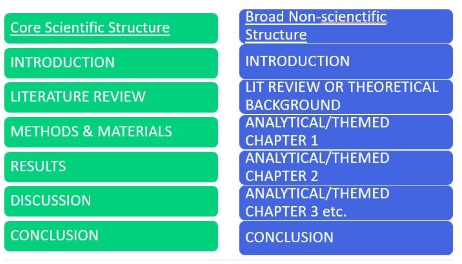
Both need an introduction as the first chapter of the main body
Both need to display an understanding of and engagement with the existing literature. In the scientific structure this is likely to be in a dedicated Literature Review chapter, in the non-scientific it may be dispersed throughout the chapters
Both need to display sound research methodology
Both need to contain strong elements of analysis and critique
Both need to come to an effective conclusion
Both need an abstract
Both need to be structurally coherent
The scientific structure sets out a widely established order and role for each of your main body chapters:
It’s worth noting the fact that although these are all discreet chapters with their own role to play, they are also heavily interlinked. To give just a few examples:
If you’re using the non-scientific structure then you have a bit more work to do in terms of deciding what each chapter will look like, and how to arrange them in the most appropriate order.
The important thing when employing a non-scientific structure is that the order of the chapters must make sense to your reader. Think carefully about how each chapter might build upon the previous one so that your ideas and arguments build over the course of your dissertation towards a logical conclusion.
Be aware also that the best order for your chapters may not reflect the chronology or timeline of your research. That is, it won’t necessarily be the best approach to have your early research reflected in the early chapters and your later research towards the end of your thesis.
Think carefully about how many chapters or sections your dissertation will have. Your aim should be to have chapters of roughly the same length – otherwise your dissertation may become lop-sided and more disjointed for your reader (remember the purpose in all of this planning is to make your reader’s life as easy as possible so as to show off your research as effectively as you can).
Structural coherence is a crucial aspect of a successful dissertation. It’s crucial that your clear about which basic structure you need to follow. Remember, in general if you’re conducting your own primary research then you’ll have your own results to gather, present and explain, and that means using the scientific structure. If you’re not gathering your own primary data, then it’s more likely that you will be following the non-scientific structure.
In this section we’ll explore a basic chapter and paragraph structure for your dissertation if you’re following the non-scientific structure.
Basic chapter structure follows the INTRODUCTION-MAIN BODY-CONCLUSION format with which most people will already be familiar. In the sections which follow we’ll break down each of these three parts in a bit more detail.
It may seem obvious at first but when it comes to writing the introduction to a main body chapter many people get confused as to what it should and shouldn’t contain, and how long or detailed it should be.
Your introduction is a key signpost – it tells your reader what the chapter is about, and where it fits into the wider structure. You do not want your chapter introduction to take up a large proportion of your word count (the bulk of which should be spent on the main body). So avoid long explanations, definitions or background detail, and make sure you don’t start actually introducing evidence and arguments at this stage.
There’s no single correct way to write a chapter introduction and to some extent the exact format will depend on the nature of the work and the conventions of your discipline. That said, adopting the simple 3-step format below will stand you in good stead in many cases.
Begin by setting out the general context or subject matter of the chapter. This will likely be a broad statement which gives your reader a sense of where this chapter fits into the dissertation overall.
Next, focus-in on the specific theme that the chapter will explore. Here you’re moving from that broad context of the dissertation into the more focused concerns of the chapter.
Finally, signpost how you will explore the theme – tell your reader what you will cover in the order that you will cover it. This is an important step in helping your reader follow your line of argument. In a dissertation chapter this might relate, for example, to any sub-headings you use to break down the chapter.
The main body is the biggest and most important section of any chapter, and is where you’ll organise your ideas and evidence into a coherent line of argument. Planning and structuring your main body is essential to writing a good chapter.
One important means of keeping control of your chapter structure is through the use of sub-sections. Dividing longer chapters into shorter sections helps you to maintain control over both the content and the structural coherence of the chapter.
Chapter sections and sub-headings also provide signposts and cues for your reader, making it easier for them to follow your arguments. Breaking a chapter into (logical) chunks and allowing your reader to pause between sections in this way is an excellent way of helping them to make sense of the text.
The key when thinking about chapter sections is to be consistent. For example, you can help your reader to absorb the text by trying to make the organisational structure broadly the same across your chapters with, for example, a similar number of sections in each chapter.
Paragraphs are another key means of controlling the structural coherence of your chapter. You should think of paragraphs as the building blocks of your writing. Each one adds to the strength and integrity of the overall structure.
It’s not enough simply to have a bunch of good paragraphs though – they also have to be organised in such a way as to flow from each other and give your writing a sense of flow.
The key rule to remember is 1 point, 1 paragraph. Each paragraph has its own job to do, its own idea or argument to evidence and elaborate on. If you try to do too much in one paragraph, your arguments are in danger of getting lost. Conversely if you don’t develop your paragraphs fully, then you’ll be left with little more than a list of bullet points rather than a well-argued thesis.
There are many different ways in which you can construct paragraphs and indeed it pays not to be too prescriptive. It’s also likely that the paragraph structure will depend to some extent on the content and complexity of the ideas being explored. However, in many cases a very basic TEA model will be perfectly adequate and will ensure that you are writing well developed, critical paragraphs.
The topic sentence outlines the point or argument that you wish to explore in that paragraph. But it can also play an important role in linking this paragraph to the previous one, thus helping your writing to ‘flow’.
Once you’ve signposted the topic, present the evidence (with citations) that you intend to draw upon to help you make your point(s) or argument(s).
You’ve made your argument, you’ve presented your supporting evidence, now give your reader the analysis. Why do you think this is important or relevant? How does the evidence help you make your argument? What is it you want your reader to notice about the evidence you have just presented? This final step is often omitted but it’s what will make your work critical rather than descriptive. If you’ve ever had feedback that you’re not being critical enough or need to be more analytical, it’s probably this step that’s missing.
Here’s a brief example of TEA in action:
Topic sentence… Whilst the volume and range of material available online means it is easier than ever to conduct extensive research, it also means that the researcher can quickly find themselves overwhelmed by the amount of material they potentially have to work through.
Evidence… Jones (2019) found that a large majority of new students were unsure how to handle the vast number of search results they encountered when researching for an assignment, although the same study noted that as time progressed students had developed much more effective strategies. Meanwhile, Black and White (2020) argue that being overwhelmed by available resources leads to procrastination and students reverting to easily accessed generic resources such as Wikipedia.
Analysis… Whilst overwhelm is clearly an issue, the solution appears to lie in equipping students with the skills to find, sift and evaluate resources quickly and effectively. As Jones found, more experienced students did not suffer from the same difficulties, having developed an understanding of how to research more effectively and efficiently. Training students at all levels, but particularly near the start of their courses, in effective research skills would reduce the problem of overwhelm and help them to make better decisions about the type of resource they used in their assignments.
Whilst the volume and range of material available online means it is easier than ever to conduct extensive research, it also means that the researcher can quickly find themselves overwhelmed by the amount of material they potentially have to work through. Jones (2019) found that a large majority of new students were unsure how to handle the vast number of search results they encountered when researching for an assignment, although the same study noted that as time progressed students had developed much more effective strategies. Meanwhile, Black and White (2020) argue that being overwhelmed by available resources leads to procrastination and students reverting to easily accessed generic resources such as Wikipedia. Whilst overwhelm is clearly an issue, the solution appears to lie in equipping students with the skills to find, sift and evaluate resources quickly and effectively. As Jones found, more experienced students did not suffer from the same difficulties, having developed an understanding of how to research more effectively and efficiently. Training students at all levels, but particularly near the start of their courses, in effective research skills would reduce the problem of overwhelm and help them to make better decisions about the type of resource they used in their assignments.
You conclusion is your final chance to get the key messages of the chapter over. It should contain no new arguments or evidence, but it should reinforce all the important points you want your reader to get out of the chapter.
The conclusion is another example of where planning can help. If you plan out your chapter before you start writing it, you can identify the conclusion you’re working towards, and that’s likely to give your writing a much more coherent sense of direction.
As was the case with the introduction, there’s no single correct way to write your conclusion. However, we would again suggest a fairly straightforward 3-step approach will work in many circumstances.
First, transition out of your main body and into your conclusion by reminding your reader of what the chapter was about. This will likely relate back to the specific theme that you outlined in your chapter introduction
Next, gather together your key findings. This is where you remind your reader of all the good analytical points you’ve made that help you build towards the final conclusion. If you have used the TEA structure in the main body, these findings would relate to the key analytical points you came up with in each section of the chapter.
Finally, provide a concluding sentence or two which broadens things back out into the wider context of your dissertation and, in so doing, leads your reader towards the next chapter.
Taking some time to carefully plan your chapter structures will mean you’re giving yourself the best chance of making those chapters as effective and efficient as possible. Consider breaking chapters down into sections based on key themes, and use effective paragraph planning to unpack these themes in a cohesive and critical manner.
This video explains how to write critically in reflective writing.
Critical reflection is an important element in many occupations and careers, and you should look positively upon opportunities to develop these skills either through assignments or more broadly as part of your course. In this resource, we'll explore exactly what we mean by critical reflection, as well as introducing a few simple models to help you begin to take a reflective approach to your work and thinking about the language of reflection, particularly in written assignments.
We all reflect all of the time. That voice in your head saying 'well that was a waste of time' or 'I really enjoyed that' is a form of reflection, although not very sophisticated and certainly not very critical. The point of critical reflection is to formalise that process in the context of a particular aspect life - often work - and to get something positive out of the process moving forward. Indeed, in a way all growth and progress depends on a critically reflective process of first analysing what happened or what we already know about something, and then using the lessons or conclusions from that to think about how we can do things differently - and more effectively - in the future.
As we've already suggested, critical reflection can lead to growth, improvement and better ways of doing things. Organisations use critical reflection to improve performance. This might be in pursuit of greater profits or efficiencies, but it can also be more focused on improving the service provided to the public - it's no coincidence, for example, that reflective practice is very common in sectors such as education and health. As individuals we can use critical reflection to improve aspects of our life. For example, as a student you might reflect on how you've approached studying or assignments in the past, thinking about elements that worked well and others that you may need to improve upon in order to (hopefully) get better marks.
CHARACTERISTICS OF CRITICAL REFLECTION
(Adapted from https://www.qmu.ac.uk/media/5533/reflection-2014.pdf )
Critical reflection became a pretty big deal in the last decades of the 20th Century, and a number of models sprang up to help reflective practitioners take a structured approach to the task. Among the most popular and enduring of these models are Kolb's Reflective Cycle (1984) and Gibbs' Reflective Cycle (1988). For a useful introduction to these and other commonly used reflective models, see this blog post. Whilst undoubtedly powerful and well worth getting to know, these formal models can be a bit complex and daunting, particularly if you're just starting out. In fact, the process of reflection needn't be complicated. In the rest of this section, we'll look at three very simple approaches that can get you started...
Our first suggestion isn't really a 'model' as such, but more a series of steps you can take that should lead to good critical reflection. In fact all of these steps are present in most of the more complex models, so you might view this is a helpful summary or distillation of the reflective process.
Describe what happened. You don't want critical reflection to be too descriptive - the emphasis is on critical after all - but a little description to set the scene is usually necessary.
Analyse what happened, including your reactions, thoughts and feelings. Analysing means breaking something down into its component parts so, for example, if an assignment didn't go so well you might break down how you time-managed the project, conducted the research, and planned and wrote-up the assignment, in order to try to establish where things went wrong.
Apply theory to what happened. Where applicable, applying theory from your course or discipline to help you put your personal reflections and experiences in context is a powerful way of making that reflection deeper and more authoritative.
Define action to be taken moving forward. Remember, critical reflection isn't only about making sense of what happened, it's also about identifying real world changes that you can make to improve the situation in the future.
Draw conclusions. Just like any academic activity, you should look to identify key takeaways from the process.
One very simple but effective model of reflection is Driscoll's 'What? So What? Now What?' model. This short video provides a helpful summary of critical reflection in general before providing an introduction to that model.
If you're getting baffled by the seemingly endless plethora of models and approaches to choose from, it's worth pointing out that they often do much the same thing. For example, the 'What, So What, Now What' model can fairly easily be mapped on to the more general model we suggested above: Describe = What? Analyse & Apply Theory = So What? Define action = Now What? So don't be too worried about the intricacies of the different models. At this stage the important thing is to begin to get comfortable with the basic steps that are common to more or less all of the different approaches.
T.E.A. is a model which we often recommend for paragraph structure in essays and other academic writing. Here's how we describe it when talking about essays:
T = Topic Sentence The topic sentence outlines the point or argument that you wish to explore in that paragraph. But it can also play an important role in linking this paragraph to the previous one, thus helping your work to 'flow'.
E = Evidence You've made your point/argument in the topic sentence, now present the evidence (with citations) that you intend to draw upon to help you make that point or argument.
A = Analysis You've made your argument, you've presented your supporting evidence, now tell us the 'so what?' - why do you think this is important or relevant? How does the evidence help you make your argument? What is it you want your reader to notice about the evidence you have just presented
So how might we adapt this model for critical reflection? Well, this is critical reflection, so we should still be identifying key points, arguments or ideas. That means the advice above for the Topic Sentence is still relevant to us here. Next comes the Evidence stage. That's still relevant too. The difference is that whereas in a standard essay we might get that evidence from say a journal article or a book, here the evidence will be drawn from the experience you are reflecting upon. You might think of this as equivalent to the 'What?' stage from the 'What? So What? Now What?' model (above). The final step is the all important Analysis. This is where you seek to explain why or how something happened and what the implications are both now and moving forward. You might also draw upon and cite some theory to help you make sense of what happened or to situate it within the context of your discipline. So this final step in the TEA process roughly equates to the 'So What' and the Now What' stages.
Reflective writing:
For more advice on reflective writing style, see this helpful resource from QMU
Perhaps the key thing to bear in mind is that writing in the first person does not mean the writing can be informal or conversational. It's important to stress this because sometime use of the personal pronoun makes it easy to slip into descriptive, diary-style storytelling rather than the incisive and critical style that is the goal of reflective writing.
Critical reflection is an increasingly important part of both student and graduate life. It can be a bit daunting at first but by understanding what critical reflection is and why we do it, adopting a model or approach that suits your style, and thinking carefully about how you write-up and structure your reflections, you can overcome any initial trepidation and begin to recognise the powerful benefits that can come from such an approach.
Whilst not as common as other types of assignment, such as essays or presentations, in some subjects reports remain an important form of assessment. As you'll see, whilst planning and writing a report shares some similarities with writing an essay, there are also some important differences.
One of the key differences between a report and an essay is in the predominant type of research reflected in the final piece of writing. When research for an essay, you mostly conduct what is known as secondary research. That is, you gather information, arguments and ideas from previously conducted research. Reports also contain secondary research - we'll explore that in more detail when we look at the structure of a report (below). However, reports are particularly designed to allow you to communicate primary research - that is, information or data that you have gathered and analysed yourself. (Note that essays can also contain primary research in some cases).
Conducting research for a report then involves more than reading already published work. It involves conducting your own research in order to gather your own data. This data might be quantitative or qualitative, or a combination of both. Quantitative data refers to data that can be measured (and therefore quantified). Common research techniques might include surveys, polls, or questionnaires with quantifiable responses but may also include working with pre-existing raw data. Qualitative data is that which can't be quantified - it can be observed but not measured. Common research techniques for this type of research might include case studies, focus groups, interviews and questionnaires with open responses. Which approach(es) you take will depend on the nature of your project and your aims. Remember though that in designing your approach you should always be able to justify your chosen methodology and, where applicable, why you've preferred one approach over another.
There are a number of different ways you can frame questions when collecting primary data. To decide which is best in any particular circumstance, you need to think carefully about the type of data you are hoping to collect. Flick through the card deck below to see a few of the main types of question, and what they're useful for...
Question types
One of the great advantages of reports is that they come with a ready made structure in place. While you might adapt that structure depending on the specific nature of your research, for the most part it will give you a framework for putting together your report.
Some of these sections will be familiar to you, but you may be unsure about others - note this a generic structure, not all sections will necessarily be relevant in your report and you may have a more fluid structure. However, most elements will be present in some shape or form
Writing a report can seem like an unfamiliar task but with a little bit of time and effort it's a format with which you can become comfortable. And it's often well worth the time - whilst it's unlikely that many people will be asked to write another essay after they graduate from university, reports are commonplace in many workplaces and sectors. So if you have a report assignment at university, see it not only as an opportunity to get a good mark but also as a potentially valuable experience for the future.
When you get an essay back, it’s natural to be most interested in the mark you received. However, far more useful going forward will be the feedback that you receive from the marker. below are some tips that will help you think about how to engage with your essay feedback in order to make sure you tackle the next essay in the best shape possible.
As you can see, there’s a lot to be gained from spending a little time contemplating the feedback you get, rather than simply concerning yourself with the grade the essay received. Why not begin now by digging out previous essays and thinking over the comments the markers have made?
This video explains the importance of academic tone in written assessments.
In this resource we’ll explore basic overall and paragraph structure for critical essays and papers.
Basic structure follows the INTRODUCTION-MAIN BODY-CONCLUSION format with which most people will already be familiar. In the sections which follow we’ll break down each of these three parts in a bit more detail.
It may seem obvious at first but when it comes to writing the introduction many people get confused as to what it should and shouldn’t contain, and how long or detailed it should be.
Your introduction is a key signpost – it tells your reader what the essay or paper is about, and how it will be structured. You do not want your introduction to take up a large proportion of your word count (the bulk of which should be spent on the main body). So avoid long explanations, definitions or background detail, and make sure you don’t start actually introducing evidence and arguments at this stage.
There’s no single correct way to write an introduction and to some extent the exact format will depend on the nature of the work and the conventions of your discipline. That said, adopting the following simple approach will stand you in good stead in most cases.
Begin by setting out the general context or subject matter of the essay or chapter. This will likely be a broad statement which gives your reader a sense of the general subject area to which the essay belongs.
Next, focus-in on the specific theme. Here you’re moving from that broad context above into the more focused concerns of the essay. What specific aspects or elements of the general subject area will you focus on? This will usually be determined by the demands of the question.
Finally, signpost how you will explore the question – tell your reader what you will cover in the order that you will cover it. This is an important step in helping your reader follow your line of argument.
The main body is the biggest and most important section of any essay or paper and is where you’ll organise your ideas and evidence into a coherent line of argument. Planning and structuring your main body is essential to writing a good essay.
One important means of keeping control of longer essays or dissertation chapters is through the use of sub-sections. Dividing longer pieces into shorter sections helps you to maintain control over both the content and the structural coherence of the chapter.
Sections and sub-headings also provide signposts and cues for your reader, making it easier for them to follow your arguments. Breaking the work into (logical) chunks and allowing your reader to pause between sections in this way is an excellent way of helping them to make sense of the text.
Paragraphs are another key means of controlling the structural coherence of your work. You should think of paragraphs as the building blocks of your writing. Each one adds to the strength and integrity of the overall structure.
It’s not enough simply to have a bunch of good paragraphs though – they also have to be organised in such a way as to flow from each other and give your writing that sense of logical flow.
The key rule to remember is 1 point, 1 paragraph. Each paragraph has its own job to do, its own idea or argument to evidence and elaborate on. If you try to do too much in one paragraph, your arguments are in danger of getting lost. Conversely if you don’t develop your paragraphs fully, then you’ll be left with little more than a list of bullet points rather than a well-argued essay.
There are many different ways in which you can construct paragraphs and indeed it pays not to be too prescriptive. It’s also likely that the paragraph structure will depend to some extent on the content and complexity of the ideas being explored. However, in many cases a very basic TEA model will be perfectly adequate and will ensure that you are writing well developed, critical paragraphs.
The topic sentence outlines the point or argument that you wish to explore in that paragraph. But it can also play an important role in linking this paragraph to the previous one, thus helping your writing to ‘flow’.
Once you’ve signposted the topic, present the evidence (with citations) that you intend to draw upon to help you make your point(s) or argument(s).
You’ve made your argument, you’ve presented your supporting evidence, now give your reader the analysis. Why do you think this is important or relevant? How does the evidence help you make your argument? What is it you want your reader to notice about the evidence you have just presented? This final step is often omitted but it’s what will make your work critical rather than descriptive. If you’ve ever had feedback that you’re not being critical enough or need to be more analytical, it’s probably this step that’s missing.
Topic sentence… Whilst the volume and range of material available online means it is easier than ever to conduct extensive research, it also means that the researcher can quickly find themselves overwhelmed by the amount of material they potentially have to work through.
Evidence… Jones (2019) found that a large majority of new students were unsure how to handle the vast number of search results they encountered when researching for an assignment, although the same study noted that as time progressed students had developed much more effective strategies. Meanwhile, Black and White (2020) argue that being overwhelmed by available resources leads to procrastination and students reverting to easily accessed generic resources such as Wikipedia.
Analysis… Whilst overwhelm is clearly an issue, the solution appears to lie in equipping students with the skills to find, sift and evaluate resources quickly and effectively. As Jones found, more experienced students did not suffer from the same difficulties, having developed an understanding of how to research more effectively and efficiently. Training students at all levels, but particularly near the start of their courses, in effective research skills would reduce the problem of overwhelm and help them to make better decisions about the type of resource they used in their assignments.
Whilst the volume and range of material available online means it is easier than ever to conduct extensive research, it also means that the researcher can quickly find themselves overwhelmed by the amount of material they potentially have to work through. Jones (2019) found that a large majority of new students were unsure how to handle the vast number of search results they encountered when researching for an assignment, although the same study noted that as time progressed students had developed much more effective strategies. Meanwhile, Black and White (2020) argue that being overwhelmed by available resources leads to procrastination and students reverting to easily accessed generic resources such as Wikipedia. Whilst overwhelm is clearly an issue, the solution appears to lie in equipping students with the skills to find, sift and evaluate resources quickly and effectively. As Jones found, more experienced students did not suffer from the same difficulties, having developed an understanding of how to research more effectively and efficiently. Training students at all levels, but particularly near the start of their courses, in effective research skills would reduce the problem of overwhelm and help them to make better decisions about the type of resource they used in their assignments.
You conclusion is your final chance to get your key messages over. It should contain no new arguments or evidence, but it should reinforce all the important points you want your reader to get out of the essay or chapter.
The conclusion is another example of where planning can help. If you plan out your essay or chapter before you start writing it, you can identify the conclusion you’re working towards, and that’s likely to give your writing much more of a sense of direction.
As was the case with the introduction, there’s no single correct way to write your conclusion. However, we would again suggest a fairly straightforward 3-step approach will work in many circumstances.
First, transition out of your main body and into your conclusion by reminding your reader of what the essay or chapter was about. This will likely relate back to the specific theme that you outlined in your introduction
Next, gather together your key findings. This is where you remind your reader of all the good analytical points you’ve made that help you build towards your conclusion. If you have used the TEA structure in the main body, these findings would relate to the key analytical points you came up with in each section.
Finally, provide a concluding sentence or two which broadens things back out into the wider context, and in doing so links back to the question you’ve been answering.
Taking some time to carefully plan your essay or chapter structure will mean you’re giving yourself the best chance of making your work as incisive and focused as possible. Consider breaking longer work down into sections based on key themes and use effective paragraph planning to unpack these themes in a cohesive and critical manner.
Writing at taught postgraduate level can be a daunting prospect, particularly if you have been out of higher education for a long time or if English is not your first language. There is often a fear factor around writing – and ‘formal academic writing’ in particular – which isn’t really warranted. In fact, there are a few basic conventions to follow – beyond that, there’s room for you to develop your own, confident voice and to let the quality of your research and your thinking shine through.
The purpose of any piece of writing you do at university is to convey your ideas and arguments as clearly and concisely as possible. It makes sense therefore to keep the process as simple as possible. Many people overcomplicate their writing, thinking that to sound ‘academic’ they have to write in an elevated style, using language and phrases that they wouldn’t normally feel comfortable using. Whilst there are certain conventions you need to follow, these are actually quite few in number and straightforward to apply. If you’re not confident in your writing, focus on understanding a few of these simple conventions and execute them as effectively as possible, then build from there.
Good writing very rarely just happens. Whilst we’d all love to be able to write just one draft of perfect prose, the truth is that writing is a messy process, and that planning, drafting and redrafting are all essential elements of producing writing of the standard expected at this level. When planning your assignments, you should always allow time for these stages. Writing that has been rushed in order to meet a submission deadline will rarely be of good quality.
Begin by planning your essay, paper, or chapter. How will you introduce it, what conclusion are you working towards, and what key points will you cover along the way (and in what order)? If you don’t have even this most basic of outlines in place, your writing is likely to meander towards a vague conclusion. By contrast, if you have a clear sense of the conclusion you’re writing towards, and of how you aim to reach that destination, then the writing will be much more focused.
You should see your first draft as just that – a first draft. Whilst you want the writing to be as good as possible, don’t be a perfectionist. Accept that at this stage the goal is to get you’re ideas down on the page, in some sort of coherent manner. You will make mistakes. That’s where redrafting, editing and proofreading come in. But you cant redraft, edit or proofread a blank page, so the first draft is about getting the ideas and arguments down in writing.
It’s at the redrafting, editing and proofreading stages that you will correct the errors, improve the writing, and make sure you are submitting a piece that’s written in an appropriate style.
In most academic writing, you will be expected to write objectively. This means using impartial language and avoiding sweeping statements, bias, and personal assumptions. You should avoid superlatives or over-emotive language and aim for a measured tone. This does not mean you can’t come to your own critical conclusions about the arguments or ideas that you encounter. It just means that you are arriving at a careful, critical evaluation rather than a subjective or uninformed opinion.
One key way to write more objectively is to write in the 3rd person, and to avoid the 1st person (I, we, our, etc.). For example, rather than writing:
I think the evidence proves that global warming is a real and urgent problem
you should use the 3rd person and write:
The evidence demonstrates that global warming is a real and urgent problem.
Can you see how the second version sounds more formal and authoritative? It’s still clearly your reading of the evidence, but it’s now written in a way that is much more formal and academic.
Note there may be occasions when you are expected or allowed to use the 1st person in an assignment, for example if you are being asked to write reflectively. In such cases, whilst it’s acceptable to use personal pronouns (I, we, our, etc.), you must take extra care that in doing so you don’t allow the writing to become over-descriptive and subjective. Most of the conventions mentioned on this page still apply to 1st person writing.
Another distinction to be aware of is that between the passive and active voice.
In the active voice, the person or thing (i.e. the actor) performing the action takes precedence. For example:
We conducted an experiment.
In the passive voice, it’s the event that takes precedence:
An experiment was conducted.
The passive voice always constructed of the verb ‘to be’ (in our example ‘was’) + the action in question (in our example ‘conducted).
Whilst it’s helpful for you to be able to recognise the distinction between active and passive voice in your writing, it’s not something you need to focus heavily on. As you may have noticed, the examples we looked at for 1st and 3rd person (above) are also examples of the active and passive voice respectively. That is to say, if you are writing in a formal, 3rd person style, it’s likely you will automatically be employing the passive voice, whilst reflective 1st person writing will employ the active voice.
At the core of academic writing is a formal style. Whilst this may sound daunting, it really boils down to following a few simple rules:
The one last thing which can adversely affect your writing is poor punctuation. Whilst there isn’t room here to go into detail about all the rules of punctuation, here are two key things to look out for:
You may be feeling a bit overwhelmed at all these conventions, all the things you need to remember. We can’t emphasise enough that the way to follow these conventions is to draft, redraft, edit and proofread. There are no short cuts – writing takes time, and involves a great deal more than just that one draft.
One final note on writing. One of the best ways of developing the skills you need to write in your subject area is to learn from the reading that you do. When you’re conducting research, don’t just read for content. Try to pay attention to the kind of language the authors employ. Look at how they use evidence. Note the ways they present their arguments.
If you find something particularly persuasive, clear or easy to read, try to work out why that was and look to emulate some of those things in your own writing. Likewise, if you find something difficult to read, try to work out why that is and avoid repeating that in your own work.
We’ve covered a lot of ground in this article and you may be feeling a bit overwhelmed by the challenge of writing academically. That’s understandable, but the key is to take things step-by-step. By mastering a few simple writing conventions and giving yourself the time and space to properly edit and proofread your work, you can develop confidence and skill in communicating your ideas clearly and appropriately.
And remember, you don’t have to master it all overnight – in fact none of us do. See it as a process, build on your successes and act on the feedback, and over time you should see your writing improve steadily.
One of the keys to writing effectively is to ensure that you write in grammatically coherent sentences. There are two particularly common sentence errors which can adversely affect the quality of your writing – run-on sentences and fragment sentences. In this short article, we’ll explore both in turn, looking at how to spot them in your own writing and, more importantly, how to fix them.
Before we look at run-on and fragment sentences, it’s important to understand the distinction between independent and dependent clauses.
An independent clause is a clause that can stand as a sentence in its own right.
A dependent clause is a clause that cannot stand as a sentence in its own right (to make any sense, it is dependent on another clause)
For example, the first sentence of this section comprises two clauses – ‘Before we look at run-on and fragment sentences‘ + ‘it’s important to understand the distinction between independent and dependent clauses‘
The first clause – ‘Before we look at run-on and fragment sentences‘ – is a dependent clause. It doesn’t mean anything on its own, it needs the second clause in order for it to make any sense.
By contrast, the second clause – ‘it’s important to understand the distinction between independent and dependent clauses’ – is an independent clause. If we took away the first clause, it could still stand as a sentence in its own right.
Once you recognise the distinction between independent and dependent clauses, you can easily understand and start to spot run-on and fragment sentences.
Run-on sentences occur when two or more independent clauses are joined together as one sentence, without the appropriate conjunction. For example, the following is a run-on sentence:
Design thinking is one way to foster effective leadership, this approach allows for a more agile and human-centred response to challenges.
Both Design thinking is one way to foster effective leadership and this approach allows for a more agile and human-centred response to challenges can stand on their own separate sentences. When they are joined together like this, they create a run-on.
We have 2 options if we want to fix a run-on sentence:
Option 1 – make them two separate sentences:
Design thinking is one way to foster effective leadership. This approach allows for a more agile and human-centred response to challenges.
Option 2 – change one of the clauses into a dependent clause:
Design thinking is one way to foster effective leadership, allowing for a more agile and human-centred response to challenges.
(In this example we’ve turned the second clause from an independent to a dependent clause – ‘Allowing for a more agile and human-centred response to challenges‘ would not now stand on its own as a sentence, it has become dependent on the preceding clause.
Fragment sentences occur when a dependent clause is treated as if it were independent. For example:
Design thinking is one way to foster effective leadership. Allowing for a more agile and human-centred response to challenges.
In this example, the first sentence is an independent clause but the second is not – it cannot stand on its own as a grammatically coherent sentence, it’s a fragment and to make any sense it is dependent on the clause which precedes it.
You may have noticed that fragment sentences are essentially just the reverse of run-on sentences. The good news is that once you learn to spot one, it’s likely you’ll also be able to spot the other. And the further good news is that our 2 options for fixing fragments mirror the fixes we’ve already seen for run-on sentences.
Option 1 – make them two separate sentences:
Design thinking is one way to foster effective leadership. This approach allows for a more agile and human-centred response to challenges.
Here we’ve simply rephrased the second clause so it does stand as an independent clause.
Option 2 – dock the dependent clause to the independent clause by making it all one sentence:
Design thinking is one way to foster effective leadership, allowing for a more agile and human-centred response to challenges.
Whilst the errors and rules we’ve discussed here can seem quite technical and impenetrable, once you understand dependent and independent clauses it becomes quite straightforward to understand how run-on and fragment sentences occur, and to spot them in your own writing.
These are by some distance the two most common sentence errors that crop up in writing at all levels. By being able to recognise and fix these errors in your own writing you will go a long way towards writing in the clear and effective manner expected of you at this level.
Editing and Proofreading Your Work
Editing and proofreading are key stages in the writing process (and they are separate stages) but they’re frequently rushed or missed out altogether. This is a failure of planning and time management. You should always build in time to properly edit and proofread your work. It’s very obvious to an experienced marker when it hasn’t happened.
Good writing rarely happens straight off the bat. Rather it’s a laborious process of crafting and recrafting until eventually you wind up with something you’re happy with. If you don’t take time to edit and proofread, it’s likely that you will be submitting sub-standard work.
It’s worth remembering that all the writing you encounter has gone through that same process. It may look effortless in its final form, but you’ll never see the graft that went into making it appear that way. If you don’t believe us, read this article by our Royal Literary Fund (RLF) Fellow, Chris Arthur. Chris is a professional essayist who also helped students with their writing during his time in his RLF role at the University of Dundee . His first paragraph on both the tribulations and the necessity of drafting and redrafting should provide comfort and instruction to us all.
You’ll find differing definitions of the distinction between editing and proofreading, and often there will appear to be overlap between the two. One possible way of thinking about it is in terms of structure and style. Editing is largely concerned with the former and proofreading the latter.
Whilst that’s possibly a slightly over simplistic way of looking at it, it does help give a sense of the distinction between the two tasks. Looking at it that way, editing is about the structure of the work both overall and in terms of paragraph and sentence structure. Proofreading on the other hand is about the fine detail. It’s about the spelling, the grammar, the syntax. It’s about consistency.
In some ways, the editing process begins at the planning stage. A plan allows you to think about structure and coherence before you start writing. Thus the more carefully you plan, the less editing you’re likely to need to do.
In terms of the editing itself, you might begin with your introduction and conclusion – are they effective? Does the former signpost to the reader the areas you go on to explore, and in what order? Does the conclusion follow naturally from the points you’ve explored in the main body?
Look also at paragraph structure – Is each of your paragraphs well-developed? Have you presented evidence and then unpacked or critiqued that evidence? Even scanning the pages quickly will give you a sense of paragraph length and may point to places where paragraphs look too long or too short. With longer paragraphs, make sure you’re not trying to cover too many points in the same paragraph – break longer paragraphs up where necessary. Very short paragraphs tend to suggest an over-descriptive approach and a lack of critical analysis. Do you need to go back and develop your arguments?
You should also try reading the first sentence of each paragraph (the topic sentence). Do they give an overall sense of the ‘narrative’? Do the points fit together in a logical order? Do you need to move anything around?
Proofreading should be the last stage of the writing process. But how do you know what to look for?
First of all, make use of the spell and grammar check functions on WORD or whichever programme you are using. You may also want to consider using the free version of a tool such as Grammarly. These will pick up many of the common errors in spelling, punctuation and grammar. Like anything else though, you have to use them critically. Don’t just accept the suggested changes without first considering whether they are valid. For example, WORD will often try to discourage you from using the passive voice when, in fact, it is quite common practice to do so in some academic writing. (You can read more about passive v active voice here).
Nowadays we have another option for proofreading our text - large language models such as ChatGTP. It's important to remember that these Generative AI models are still only tools, Our advice above stands - you must use them critically and you are the final human arbiter of what is right and wrong. See our section on GAI for more advice on how to use these tools ethically and effectively.
Regardless of whether or not you use an online tool, you should always manually proofread your work. There are lots of different techniques you can use. The Royal Literary Fund have produced this handy guide to proofreading your own work.
One thing you should always do when proofreading your work is pay attention to the feedback you’ve received on previous work from your markers, your supervisor, or other people.
It’s sometimes tempting to ignore or skim over the feedback, and it can be tough to hear about all the things we’ve done ‘wrong’. But instead of seeing feedback as criticism, try to look upon it as free advice on how to improve the work. Feedback is never personal – it’s a reflection on the work, not on you personally, and is offered constructively to recognise the things you are doing well and to help you work on the areas that need development.
So pay attention to your feedback and use it as feedforward for your future writing. And when you’re proofreading your work, be extra careful to check that you’ve addressed to the best of your ability the issues raised in that previous feedback.
By mastering a few simple writing conventions and giving yourself the time and space to properly edit and proofread your work, you can develop confidence and skill in communicating your ideas and your research in writing. And remember, you don’t have to master it all overnight – in fact none of us do. See it as a process, build on your successes and act on the feedback, and over time you should see your writing improve steadily.